This Thanksgiving I made my way to the Denver area to visit my brother, and I decided to touch upon the topic of grilling at high altitudes (5000-8000 feet above sea level). At higher altitudes, there is lower air pressure and as a result the boiling point of water drops. At sea level, water normally boils at 212′ F while at 7,000 feet water boils at 198′ F due to the fact there is less pressure to inhibit the boiling of the water (this can fluctuate due to the additives in the water, barometric pressure, etc). Another side effect of the high altitude is the liquids will evaporate more quickly so you’ll need to take this into account as well.
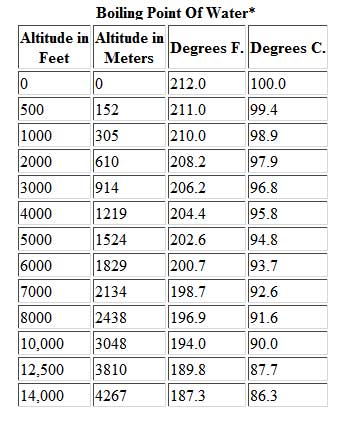
 When cooking at high altitudes, food will take longer to cook because it is actually cooking at a lower temperature, and due to the evaporation effect you’ll need to use more liquids. Be careful not to cook your food too fast, as the outside can quickly get crispy from losing moisture, and the inner portions will still not be throughly cooked. Since we are doing a turkey I’ll cover some tips for cooking turkey at high altitudes. You can use these tips for practically any type of poultry and beef.
- Don’t tie the turkey legs together. This allows air and heat to circulate over all parts of the bird.
- Do not stuff the turkey (In fact, don’t stuff the turkey at any elevation).
- Placing heavy duty foil between the lid and your food will direct heat and help considerably in higher elevations (This can take a little practice, be careful to evenly distribute heat and allow for circulation).
- Try and keep your temperature lower than normal in high elevations as cooking too fast will crisp the outside and the inside will not reach proper temperature.
- Keep the lid closed as much as possible.
- Do not pierce the bird unnecessarily as this releases moisture. Use tongs or gloves to turn the bird.
- Cook to an internal temperature of 165′ F. This will prevent a dried out bird.
- Let turkey rest breast-side down for 15-20 minutes to allow moisture to pull back into turkey.
For information on baking and other forms of cooking at high elevations, see this collection of resources from About.com
Would love to hear about high altitude smoking. I live in CO at about 7300 feet and need some tips. Topics could include:
1) Keeping a charcoal fire at a consistent temp for long periods in low O2 environs
2) Tips like adding or subtracting a little time, cooking a little hotter or cooler etc
My wife uses the Pie in the Sky Cookbook that lists out recipes and the changes to make at various altitudes. Would love to see something like that for BBQ
@Sean – We’ll definitely put that on the list! Next time I’m in Colorado I’ll do a similar post (Kansas doesn’t really qualify as high altitude!)
Thanks, about 2 hours before the turkey was done we thought about this and decided to research. Thanks for the info.
Just need some help from you experts.
Is the water temperature be different only at the boiling point between the sea level area and the high altitude area? or it is different at each the water temperature level (eg, 60C in 0 altitude area is not 60C in 5000 feet altitude area?)
Many thanks!
@Jack – The short answer is that the individual temperatures remain the same. The long answer is that the change in boil point happens because the atmospheric pressure changes at different altitude. The higher up you get, the thinner the air gets, which means the atmosphere is putting less force on the objects in it. The boiling point is the temperature at which vapor pressure of a liquid is equal to the atmospheric pressure placed upon it. So if the atmosphere isn’t pushing as hard on your pot of water, then it takes less vapor pressure to achieve equilibrium (which means your pot of water will boil at a lower temperature).
@Jason – many thanks! So there is no difference cooking at the sea level and high altitude area if I only need to cook at the temperature below the boiling point?
im looking at replacing my old propane gas grill with a new infra red grill. any comments on how these work at high altitude? 7000-9000 ft. thanks
I live in Colorado, elevation 10,200′ MSL, OAT 15F, I have a Green Egg, which I love but hard to get a hot fire at this elevation and temp. Any ideas.